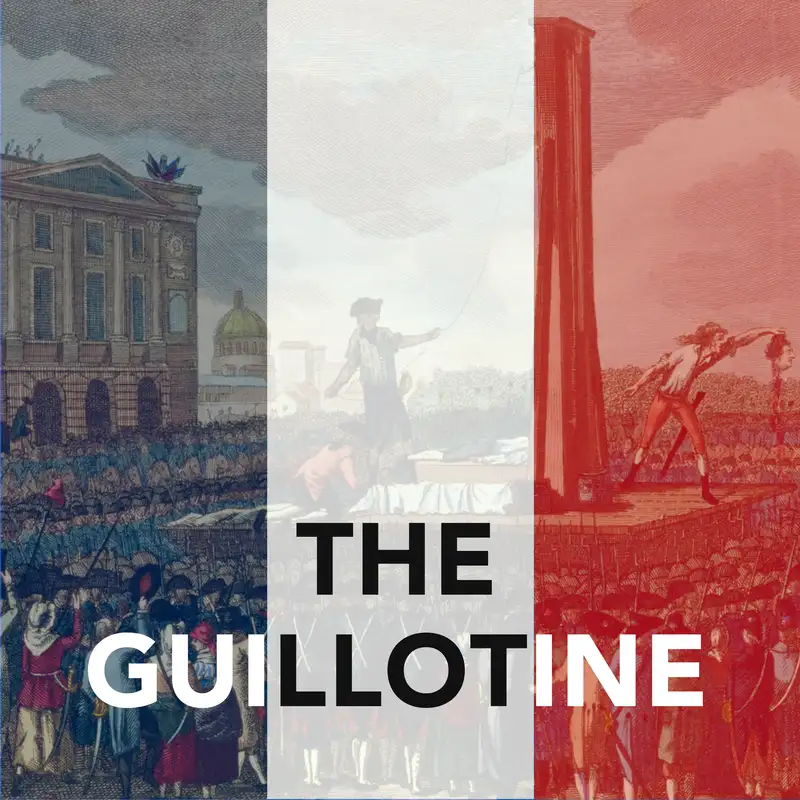
The Guillotine: Grandfather Clock of Death (1/2)
Download MP3tb guillotine pt 1
===
Theme music
---
[00:00:00]
Welcome
---
Dan Slimmon: Bonne fête nationale, listeners. Happy Bastille Day. Uh, this is Technology Blows. Welcome to Technology Blows, the techno-pessimist podcast that believes your head should stay attached to your body. Uh, we're a little, we're a little controversial there. We think all th- all, all else being equal, just keep those things stacked up like normal.
I'm Dan Slimmon, and with me today is my guest, my friend, technologist, painter, [00:01:00] Frenchman, Johann Romefort. Welcome, Johann
Johann: Thank you so much, Dan.
Dan Slimmon: I'm so ex- I'm, I'm really excited, uh, to have Johann on the show. Johann and I talk only about, you know, mostly about computers, uh, when we chat with each other, and now we're gonna talk about something that is, uh, not a computer, but still a very important piece of technology, the guillotine. Uh, what do you know about the guillotine?
How much do you know about the guillotine, Johann?
Johann: Uh, cuts really hard. Um,
Dan Slimmon: Yeah
Johann: yeah, I mean, French invention, uh, has been quite used, right? Like, uh, effective at what it does,
Dan Slimmon: Yeah
Johann: I would say. Uh, a-and
Dan Slimmon: can s-
Johann: well, right? Like it's, uh, it's fast. Uh, it's probably [00:02:00] I
Dan Slimmon: Yeah
Johann: I haven't tried it.
Dan Slimmon: Really? Yeah. Eden just like, "Ah, man, uh, I wonder might, might be therapeutic today. You know what? I'll build a guillotine."
Yeah, there's, there's some debate. Um, but, well, we're not gonna talk about it too much on the episode, but there, there was some debate about whether the guillotine actually is a painless way to die. Uh, but I, I, as far as I can tell on balance, the evidence seems to show that, yeah, you're pretty much dead once your head's off, so.
so that's good at least
Johann: Yeah.
I
Dan Slimmon: thank you for
Johann: remains to, to know if like the head still functions afterwards, right? Like
Dan Slimmon: Yeah
Johann: some moment maybe or the...
Dan Slimmon: Yeah. Um, well, w- well,
How long does the head survive?
---
Dan Slimmon: so since it's not in the script, I'll just, I, uh, we can get into it now. So, uh, but there's, there's not like, um, there, there was a guy called, uh, I [00:03:00] forget his name, in like the early 1900s who witnessed an execution and would try to do like science on the scaffold and watch, you know, this guy...
They chopped this guy's head off. The guy's name was Languille, and, uh, he waited for after the execution, after the head was chopped off, and he like pointed the head toward himself and just yells in his face, "Languille." And he says, he says the guy's eyes opened up and l- and he looked at him.
Johann: Oh, wow. Oh,
Dan Slimmon: but it's never been repeated.
We don't really know
Johann: Yeah.
Dan Slimmon: What a pain in the ass. Yeah, I mean right? Like, man, I thought we were done here. I thought once the head came off, I was gonna be, like, d- didn't have to deal with assholes yelling at me anymore, and then this guy
The American image of the guillotine
---
Dan Slimmon: So the guillotine is, is one of the most influential technologies ever to come out of France, right up there with the bicycle, right up there with milk that doesn't [00:04:00] have E.
coli in it. The, the guillotine is one of the best F- French inventions of, of all time. Uh, over here in America, we don't think about the guillotine very much. W- when we do think about it, it's usually we're thinking about Marie Antoinette. We know she famously spent a ton of state money on various luxurious silks and had, uh, a whole farm built on the grounds of Versailles so she could cosplay being a farmer, and then she was beheaded by angry, starving peasants after telling them to eat cake.
That's pretty much the average American's image of, of Marie Antoinette and the guillotine. which makes Marie Antoinette into a symbol f- for us of, like, the idle, ultra-rich, exploitation, g- exploiter class, right? She, she sort of stands for your, your Donalds Trump, your Elons Musk, your Zucks.
And so the guillotine ends up [00:05:00] resi- representing sort of the righteous anger of the working class. Uh, it's a powerful symbol of that, but in these episodes we're gonna talk our way through how the guillotine was actually employed in real life, and I hope to convince our listeners that this, this is a machine that has never really been a weapon of the working class.
A- a- and that, like, if you see the guillotine as a, as a tool for chopping off the heads of the rich, you're missing its real fundamental purpose in society So
What execution is for
---
Dan Slimmon: What would you say the guillotine's purpose is?
Johann: Or I guess to jump heads.
Dan Slimmon: Precisely. Precisely.
Johann: it's pretty
Dan Slimmon: Yeah.
Johann: Yeah
Dan Slimmon: Episode over. No, I mean, it, you could ch- it chops heads, right? But like, it's a way to kill people, right? You, you kill, you got people you need killed, boom, chop their head off, dead. But killing people's pretty simple. Uh, y- you don't really need a [00:06:00] whole machine to kill people.
There's, like, hundreds of ways to kill people. Most of them you can do without a whole, you know, rope and pulley system and a special copper bucket. But, uh, executing people is much more complicated than just killing people. Uh, 'cause, because when a state decides to execute someone, they need to make it mean something, right?
You can't just kill people any old way. You have to surround it with symbolism and ritual in order to make it, the meaning of the execution unmistakable. Otherwise, people might just think it's state-approved murder, right?
Johann: I try. So that's, I, I guess there's a public aspect of the guillotine, right? Like, that it's on the public place with, like, people attending, and also le bourreau, uh, which is
Dan Slimmon: Yes
Johann: his head. Uh, it's almost like, uh, some sort of [00:07:00] weird ritual, right?
Dan Slimmon: Exactly. Yeah, the, the, uh, exactly, it's a re- weird ritual. And like rituals are there to m- to mean something to the people who participate in them. And, and see, the, the, the stuff about the executioners I read up on, uh, was fascinating, that they, that like for a long time the executioners would be, and all, pretty much in the UK and, and also in France and throughout the rest of Europe, if you were an executioner, like chances are your father was an executioner and your grandfather was an executioner all the way going back like five or six generations
Johann: That's,
Dan Slimmon: Uh
Johann: trauma, I guess, right? Like right there.
Dan Slimmon: Who else can deal with it?
Johann: Yeah.
Dan Slimmon: Uh, yeah. It's just, "What, you wanna be a doctor? No son of mine is gonna be a [00:08:00] doctor"
yeah, so the, so the state, the specific meaning of what you want to convey with the execution constrains what kind of executions you're gonna decide to do. So for example, if you want to convey a message that, like, the state's right to execute derives from its rational, methodical process of judgment, you might pick a science-y execution method like the lethal injection or the electric chair, like we do over here.
If you want to convey that a, a witch is the embodiment of sin and sin has to be purged from the world, then burning at the stake might be the way to go. So whoosh, right? Doesn't get much, doesn't get much pursier than that. Um, if the meaning you want to convey is that chewing gum is a nasty, gross habit, then you might execute your victim by turning her into a giant blueberry and having Oompa Loompas roll her down into a garbage chute, right?[00:09:00]
It's all about the symbolic weight of it, um, right? And there's no weight more pointed or symbolic than the blade of the guillotine. A device so primed for meaning that more than 230 years after its heyday and almost 50 years after its last use, it still regularly shows up on protest signs all the way over here, standing for ideas that neither its inventors nor its earliest victims could ever have imagined in their time.
right, it just, like, stands, it stands up there and it just, like, gets in your head, so to speak.
Johann: So it's like
François Ravaillac, the regicide
---
Dan Slimmon: so Johann, ever been drawn and quartered?
Johann: Sorry
Dan Slimmon: You ever been drawn and quartered?
Johann: N-no
Dan Slimmon: You know what a drawn, drawn and quartered is? It's, uh, in, in French they call it l'écartèlement
Johann: Oh, [00:10:00] okay. Yeah, yeah. No, I
Dan Slimmon: yeah, yeah
Johann: have a bit. Yeah
Dan Slimmon: Doesn't seem like a good time
Johann: Yeah
Dan Slimmon: Um, yeah, this is the one... So if you don't know drawing, drawing and quartering, this is the one where they, they tie your arms and legs up to four horses, and they have all the horses walk in different directions.
Johann: Yeah, that's right. Yeah. Yeah. There
Dan Slimmon: yeah. Maybe the most famous guy to-
Johann: the wheel as well, no? Like, uh, that they would spin and it would just like dismember you
Dan Slimmon: Yeah, they did. They came up with a lot of stuff, man.
There, there was... So the wheel, we'll talk about the wheel a little bit, but that was the, with your br- being broken on the wheel, um, a- apparently it mostly involved just having a big wagon wheel smashed down on top of your bones over and over. Um, not, not super good, but, but, uh, o- oh, drawing and quartering was the one [00:11:00] they, uh, they reserved for, like, the worst possible punishment of people.
M- maybe the most famous guy to be drawn and quartered, at least in France, is this guy called François Ravaillac. So François is the guy who, in 1610, jumps into the royal carriage, stabs King Henry IV twice in the chest, and kills him Now we don't know exactly why Ravaillac murdered the king in 1610. We know he's a devout Catholic and he thinks Henry IV isn't doing enough to like bring Protestants back into Catholicism.
Um, you, you guys, you guys were on this Protestantism, Cath- Catholicism thing for a long fucking time. Uh, could not let it go. We, we know Ravaillac had a lot of resentment toward his absolute dirtbag of a father who left him when he was a kid, and also toward a lot of other male authority [00:12:00] figures.
You know, this is a common pattern now we know , he's, he's particularly angry at monks because Ravaillac briefly joined a monastic sect, uh, but then he got kicked out because he was having visions And the visions are important.
He would have, he would have visions like he would feel like his feet were on fire. He would f- he would smell sulfur, uh, that wasn't there. He would... had visions of himself playing a trumpet of war, like he was starting a war by, and, and fighting in a war, um, alongside other soldiers. In the modern day, we would probably diagnose this guy with a mental illness.
But, you know, this is the 1500, 1600s
Johann: Take psychedelics, maybe
Dan Slimmon: Right.
Johann: some
Dan Slimmon: And there was... Right. There were psychologics, there were psychedelics in everything back then. Like, we didn't have pasteurization yet, right?
Johann: That's right. That's right
Dan Slimmon: So it's all over the street. There's just mushrooms [00:13:00] growing everywhere, you'd trip down an alleyway, accidentally eat some mushrooms, and now you're tripping your way back out of the alleyway
but this, this, these visions were with him his whole, his whole life. Ravaillac definitely does not have a coherent reason for wanting to kill the king. He's much more of like a John Hinckley Jr.,
who was the guy who, who tried to kill, um, Reagan than, than like a John Wilkes Booth, who was the guy who tried to kill, uh, who, who killed Lincoln, right? John, John Hinckley Jr. believed that, uh, if he, if he assassinated Re- Jo- Ronald Reagan, then, uh, Jodie Foster would, would finally notice him and fall in love with him w- that was much more of a Ravaillac sort of thinking to it.
he's like a lone wolf with some mental problems who feels compelled to kill an important man, and that important man is the king. One thing we do know about Ravaillac is that he's not afraid to die. He goes and talks to priests [00:14:00] 1608, 1609, the years leading up to the assassination, but he never tells them exactly what he's planning to do because he, quote, "Feared that he would be put to death for the intention rather than the deed." Right. If he tells the priests too much, then they'll report him to the authorities and, you know.
Right. So, so he doesn't tell them exactly what he's gonna do, but he hints at it, and he knows he's going to die for it when he, when he does kill the king. Like, he's not gonna survive. And then in 1610, he goes ahead and does it. Just pops right in there, boop, boop, king is dead. So
Johann: Done
Dan Slimmon: Ravaillac... Done, right?
It was really... It's not that hard to kill a king in 1610. He's just in his carriage w- driving around.
Johann: Yeah. It's not like you have snipers on, on the roof and
Dan Slimmon: Right.
Johann: like that
Dan Slimmon: Right. Nowadays, I imagine it would be pretty hard. I've never looked into it. so, so after Ravaillac mercs the king, he immediately surrenders to the [00:15:00] King's Guard because there's an angry mob outside the carriage yelling, "He must die," and trying to rip him apart.
So, you know, free ride to the prison in a cozy carriage sounds, sounds pretty nice compared to getting ripped apart right now.
Why we draw & quarter
---
Dan Slimmon: But unfortunately for our boy Frankie, killing the king happens to be the only crime in France that you can get drawn and quartered for. It's, it's such a cruel punishment and so complicated to do, so time-consuming, that it's reserved for regicides.
And I think we all know enough about drawing and quartering that I don't have to go into the gory details of drawing and quartering, but if you haven't read the gory details recently, it's even more heinous than you probably remember. It's, it's an all-day affair. It involves mallets. It involves hot sulfur.
It's like, it's shit Jigsaw from s- the Saw movies would look at and be like, "Woof, really? I [00:16:00] don't know, guys." so it's, it's bad, and it serves, it serves three basic functions. Okay, function number one: it's supposed to deter crime, right? Henry IV's son, who's the king now, doesn't want some other crazy Catholic motherfucker to stab him, so the idea is this complicated public torture demonstration ought to make people think twice about killing another king.
And it would probably deter me personally. Like, no thank you. Um, but on the other hand, deterrence doesn't work on everyone,
Johann: Probably this guy would not have been deterred, right? Like, uh, he knew what was gonna happen. So there's probably some like him that would be ready to do it as well
Dan Slimmon: He knew, he knew exactly what was gonna happen. but he's, you know, he's getting visions from God, right? It's, it's like, uh, it do- deterrence [00:17:00] doesn't work if you're, if you're trying to impress Jodie Foster or if God tells you you need to start a religious war. Uh, so, you know, strike one. Another function drawing and quartering serves is it reinforces the king's connection to God.
Because when Ravaillac finally dies, they s- they, they believe his soul is gonna go up to heaven, is gonna go up to be, to be judged by God by, at the pearly gates, right? And unless those visions really were from God, God is gonna be pissed that, that, uh, this guy killed his boy Ra- uh, Henry IV. So that, so on the day of the execution, you've got all these cardinals and ministers and, and everybody up there giving speeches about how this punishment is actually an act of mercy, and the, you know, the king can absolve you from even the worst sin by subjecting you to this hellish torture.
so that's, that's, that's idea number two of, of drawing and [00:18:00] quartering. Um, sort of present that message to people. Hopefully they believe it. And last but not least, drawing and quartering creates an opportunity for collective vengeance. You know, it gets, gets the people together in the street. There's
And that there's nothing like ripping apart a corpse with your bare hands in a feral rage to, to bring people together, really reminding them that the, the king is, the king is on their side. If, if there's a injustice, the king is gonna make sure that they get a chance to ... That, that you get a chance to, you know, live out your, your blood thirst
which is too bad, like Ravaillac wanted to go get in the carriage instead of getting ripped apart by the crowd. He ended up getting ripped apart by the crowd anyway. So w- would've been better off just like, doing some crowd surfing after he
Johann: Definitely.
Dan Slimmon: came out of that carriage
so anyway, if you kill the king, you get drawn and quartered, so that's a bad one. Definitely don't kill the king in France in 1610.
Other French execution methods
---
Dan Slimmon: Now, if you didn't kill the [00:19:00] king, but the French state still wants you dead, how are they gonna execute you? It depends. Are you a noble or at least wealthy? Then you might get to be beheaded with a, with a sword or an ax.
Quick, relatively honorable, a bit messy, but hey, you're not the one who has to clean up after, right?
Johann: Exactly
Dan Slimmon: so if you're not a noble, if you're a commoner, then you probably either get hanged, or if you've done something really, really bad, you get broken on the wheel like we talked about, uh, earlier. Um, you can look this up, what that is. It's not great. Um, they're just, like, smashing you with a big old wagon wheel.
Uh, and, uh, you don't get to... They don't do that to you if you're a noble, right? Nobles get to be beheaded
The 1789 Revolution
---
Dan Slimmon: So it's sort of a two-tiered system of justice, and that's exactly the sort of thing that's gonna be on the [00:20:00] chopping block in June of 1789 when the revolution pops off. You know, we- people talk a lot of shit about the French, but boy, do you guys know how to put on a capital R revolution. It's, it's amazing. Um
Johann: I think
Dan Slimmon: Yeah.
Johann: like a
Dan Slimmon: It's got...
Johann: revolutionary flair, right?
Dan Slimmon: Hell yeah.
Johann: I found kind of funny 'cause I lived in the US for a while, right? Like, and remember seeing a protest, I think it was, it was in San Francisco in front of a hotel. And, uh, y- y- you had like, I don't know, five people, walking around with like a little sign. I was like, "What is this?"
Like, this is not how you, you strike. This is ridiculous.
Dan Slimmon: Yeah
Johann: lock up the, the CEO in his office, and, uh, you chain him to, to the radiator. And, uh, yeah.[00:21:00]
Dan Slimmon: Yeah
Johann: it's interesting how... A-
Dan Slimmon: Yeah
Johann: seen actually, uh, i- in, in France, like, uh, I've seen some very violent, like, protest and, and, and things like that.
Like, yeah, we, we know how to, to make a point when it, it's needed, I guess. Uh,
Dan Slimmon: That's for sure.
Johann: There should be, there
Dan Slimmon: That's for sure. Yeah, we don't know how to do it
Johann: you know, like, uh, yeah
Dan Slimmon: We gotta send our revolutionaries over there, for sure.
Johann: Yeah, yeah
Dan Slimmon: Um, and it ke- keeps coming back. Like every generation you guys are like, "We need to fuck some shit up. Let's fuck some shit up." Um, I, I love it. Uh, the ... So yeah, the French Revolution's fantastic. It's got everything. It's got half-naked ladies waving bloody flags.
It's got a whole ... They invented a whole new calendar which has days named after vegetables. You got thousands of women storming Versailles with pitchforks and threatening [00:22:00] to stab the king. It's just like an S-tier revolution, no notes.
Johann: Mm-hmm.
Dan Slimmon: Uh, maybe some notes, but we'll, we'll, we'll, we'll, we'll get there. Uh, so anyway, the French Revolution, there's a new constituent assembly is, and that, that's making laws, and they're just throwing all the old feudal privileges into the bonfire.
You know, special hunting rights for nobles? Blammo. Tax exemptions for aristocrats? Au revoir, mon gars. Tithing, where you have to pay 10% of your income to the, the church? "How about the church can have 10% of my ass?" they say
and it's into this bonfire of privileges that a doctor named Joseph-Ignace Guillotin casts the two-tier execution system. So Guillotin is not exactly an A-list revolutionary figure. You know, he's no Georges Danton or, like, Jean-Paul Marat
but he's a respected man of science, right? He's, [00:23:00] he's been... He's a doctor. He's been elected to the National Assembly, so he's no slouch. one of Guillotin's lesser-known claims to fame is that on June 20th, 1789, when King Louis XVI has his little pissy fit and locks the Third Estate delegates out of their chambers, and everybody's milling around being like, "Well, shit, we can't make laws if we can't get into our law-making room.
What do we do now?" Guillotin is the guy who pipes up like, uh, "I know a tennis court we could go to. If you guys don't mind making laws on a tennis court, we could try that." And that's, that's how we get the famous Tennis Court Oath, the, where the, um... W- a lot of people consider the first official act of the revolution, where all these, all these Third Estate delegates, you know, meaning their, their legal representatives of the commoners as opposed to the nobility or the clergy.
These guys are... basically declare themselves the only legitimate legislative body. and I [00:24:00] have the painting here, of course, the famous, uh, Jacques-Louis David painting of the Tennis Court Oath. Guillotin's in there somewhere He's probably thinking, Boy, I hope, I hope people remember me for thinking of going to this tennis court rather than anything else I might do in my career."
so these guys, so these guys take over Tennis Court. They start making laws. They get started right away, and on August 14, seven- uh, August 4th, 1789, in one crazy night, they, they just throw out all the old unequal laws, which is all the laws. They basically just abolish feudalism in one night of crazy lawmaking.
And the next day, the delegates wake up feeling like shit. They're all like, "Oh, what did we do last night? Did we rip up all the laws? Fuck. Now we're gonna have to write all new laws."[00:25:00]
Johann: There was no, uh, no ChatGPT, so it's a lot of work to, to write that.
Dan Slimmon: Right
Johann: Imagine if now all laws would be rewritten by AI. That would, that would be interesting
Dan Slimmon: this is a genuinely sharp constitution, and, it proves that France is not just a, a group of people vying for rights, but a nation.
so they're writing laws. They gotta write all their laws by hand like fucking chumps, and they gotta write laws on everything, and that includes criminal punishment.
Guillotin's proposal
---
Dan Slimmon: There needs to be a new penal code. So our boy Guillotin takes an active hand in writing this penal code. He... And he gets involved in this because, largely because he's against the death penalty. He, he wants to, he wants to ban the death penalty. Yeah.
Johann: That's a, a miss?
Dan Slimmon: I know.
Johann: Oops
Dan Slimmon: [00:26:00] Yeah.
It's amazing. Uh, 'cause they won't let him ban the death penalty. They're like, "Well, we need to, we need to be able to kill people, otherwise what's the point of having a state?"
So he doesn't get anywhere with banning the, the, the death penalty. So instead, he tries to do, um, what he can to make execution a little bit more humane and a li- a lot more egalitarian. So in October of 1789, he puts forth a proposal that first of all, all punishments for the same class of crime shall be the same regardless of the criminal.
In other words, no more punishments for nobles. Everybody gets punished the same way. And second of all, when the death penalty is applied, it will be by decapitation carried out by a machine So he's the guy, that's the reason this, his name gets attached to this is [00:27:00] he's the one who got, comes up with the idea for doing it with a machine
Johann: I see. I see
Dan Slimmon: Right? But he's trying to be humanitarian here. He's trying to say like, "Well, let's not e- let's not do it in a painful way. Let's not have rip people's arms and legs off with horses. Let's not smash them with a wheel. Let's just have a machine that can quickly and painlessly take off the head," uh, w- w- which he's, he's quoted maybe apocryphally as saying, "In the twinkling of an eye, my machine will take your head off."
Johann: Yeah, indeed
Dan Slimmon: yeah, it sure did. that's how, that's how the, um, you know, the newspapers get ahold of the fact that this, this twinkling of an eye quote, and everybody, the common people out on the streets are, like, making up songs about how Guillotine's gonna cut your head off in the twinkling of an eye. And the songs all get spread around, and everybody starts calling this thing The Machine Guillotine, and the, the name sticks.[00:28:00]
Uh, which is, which is funny, but it's also a shame. Too bad for this guy really fucked up. eventually, in September of 1791... Yeah, go ahead.
He didn't... No, he did not, he's not just build it.
Johann: Okay, I see. I see
Dan Slimmon: It was ju- it was just his idea to make there be a machine. He sort of, um, you know, he project managed it
Johann: I see you. Yeah
Antoine Louis' proof-of-concept
---
Dan Slimmon: The guy who was... So the, the guy who did the POC is the guy we're gonna talk about next, which is Antoine, Antoine Louis. Um, he's one of, he's one of three im- important Louis in this story, so, uh, you know, let's keep them straight. Antoine Louis is, is the guy who invents the guillotine. They don't actually call it the guillotine at first because they, they're still working inside their administrative bubble.
They call it the Louisette after Antoine Louis. So, uh, Louis gets, sets up shop [00:29:00] in Paris, and he's testing different techniques. uh, he's iterating on his POC. He's mostly using sheep to test, and he goes through, like, a lot of sheep just, um Move, move fast and cleave things is, I guess.
One, one challenge that comes up with the sheep is that if you have the blade go... If the blade goes... Oh, I love that. You have a, um, yeah, a European police klaxon. I love to hear that.
Johann: Yeah, yeah.
Dan Slimmon: We never get to hear those over here. Our sirens are terrible. Um, so he's testing, he's going through sheep, and one challenge that comes up is that if you wanna get the, you have to get the shape of the blade right.
If you, if you have a blade that's straight across, that's no good. That's chopping, right? Works for carrots, but as anyone who's ever broken down a chicken can tell you, if you wanna get through muscle and bone and tendons, [00:30:00] you gotta be slicing, not, not chopping. Chopping's not gonna work. So they try a convex blade, sort of like a half-moon shaped w- uh, blade, so that maybe it's more of a slicing motion, but still not great.
Tends to get gummed up in the sheep vertebrae. You know, everybody's had that problem. And so now I got some trivia for you, Johann. Do you know who it is who apparently finally comes up with the blade design that works correctly?
I'll give you a hint. It's a guy who famously likes to tinker with locks and other machines
King Louis XVI
Johann: Oh, wow. Really?
Dan Slimmon: Yeah. Apparently, uh, this is from the d- the, uh, diaries of the executioners, so we, they may, you know, they may have thrown in some tall tales in here. But at least according to legend, King Louis XVI visits [00:31:00] Antoine Louis' lab to see how this nifty new head-slicing machine is coming along, and he's the guy who's like, "Oh, you know, you ought to make it cut at an angle like a paring knife, 'cause, you know, that's really gonna slice right through the neck, man."
And he- he's
Johann: And boom.
Dan Slimmon: "Anyway, it's really coming along, buddy. Can't wait to see it in action. Peace out."
Johann: Interesting.
The design of the first guillotine
---
Johann: was there anything with like also how, uh, how tall the machine should be so the gravity, like you, you, you get the acceleration right? Like this-- There's a lot of parameters when you think about it, right? That to make sure that it does what it needs to do. It needs to be heavy
Dan Slimmon: it, there's a lot, there's a lot to think about,
Johann: Yeah.
Dan Slimmon: right? It needs to work, it doesn't need, it don't need, it only needs to do one thing, but it needs to do that thing every time. [00:32:00] Yeah, um, so what they, there's a bunch of different ways you could do it, right? But the way they're working with late 1700s technology, So what they end up with is they have a three-meter tall pair of uprights held together with a crossbar at the top that's called the chapiteau, and three meters for our American listeners is about 10 feet. Uh, and hanging, there's, from the rope up at the top of the crossbar is a blade.
That's the, um, the iconic, you know, slanted blade that we all know and love of the guillotine. and that blade, on top of that blade, they have a 15-kilogram weight for maximum thud. 15 kilograms is about 33 pounds. as anybody knows who's taken some physics, the weight doesn't make the blade fall any faster, but, you know, it sort of helps it power through.
Once it hits the neck, it going whatever speed it's going, it helps it, like, power through the wes- [00:33:00] rest of the way down. three, three meters I think is just about what they were a- what they were... I got to imagine, like, when they were now trying to, like, lug this thing out of the offices, they gotta make it fit through the door like when you're moving a sofa
Johann: Yeah, it's painful. I have a, I have a table that is one piece of three meters, so I can relate to... It's pretty small actually for-- I, I thought this device was actually much, much taller than, than three meters. But it makes sense, I guess,
Dan Slimmon: Yeah
Johann: to get it, like, to move it around
Dan Slimmon: It feels like it would be taller, right?
Johann: Yeah, yeah, absolutely
Dan Slimmon: But I think it just... I think it's just because it, like, it's up there on the scaffold. They, they put it on a scaffold so it's up above everybody, so it looks really tall. And then they, when in, in paintings, they usually have, like, a flag flying behind it, so it looks like, uh,
Johann: Yeah,
Dan Slimmon: really way up there. but yeah, th- three meters, still, you know, three meters is enough.
That'll, that'll get the head [00:34:00] off, so the victim, or client, as the executioners say, sometimes they say package, um, but the, the client is laid chest down on a platform, and his or her head goes through this semi-circular hole at the base of the uprights, and a cross piece is placed over the, the top.
The cross piece is called the lunette,
uh, over the back of the neck so that the head stays in place. And then the executioner releases the rope, the blade assembly falls under its own weight, it runs along little tracks cut into the uprights so it goes straight down, and if all goes well, fwp, thud, head drops into a basket, the body gets shoved off the platform into a big box, which can hold up to four bodies at a time.
And the blade is cleaned, sh- and raised back up to the crossbar, and we're ready to go again
Johann: I mean, why did they even clean it? The real question
Dan Slimmon: Mm. [00:35:00] I think the main reason they cleaned it is because
Johann: yeah
Dan Slimmon: it cuts better if it's clean.
Johann: Yeah.
Dan Slimmon: Yeah.
Johann: they have some times to, to actually sharpen it again?
Dan Slimmon: Yes.
Johann: Yeah
Dan Slimmon: but then, but the, but they'd not, not between executions, I think, cause that would take a long time. You had to disassemble the thing and take the blade out and sharpen it, right? That, that was, that was one of the reasons... That was one of the big problem, the reasons that the executioners were so excited about the guillotine is because they would have to-- When they were doing the executions with swords or axes, they would have to either sharpen the sword every time, which takes forever, or they had to have, like, 30 swords ready, every time.
And if any of them is, any of them's not sharp enough, then you're hacking, and when you start hacking, it makes the crowd angry, and sometimes people would ru-run up and
Johann: Right
Dan Slimmon: beat the shit out of the executioner. So the gui-guillotine's better for that
Johann: S-so I guess [00:36:00] like one improvement that could have been done would be to remove the blade and put another one easily, right? A bit like razors, basically. That, that would have been probably a V2.
Dan Slimmon: Yes. Well, we'll get to V2 actually.
Johann: Okay.
Dan Slimmon: it didn't, they did, they didn't do that. Um, they didn't do that for V2, but they did make it a lot more, um... They made, they made a lot of really good improvements.
Johann: Anyone thought about doing like, uh, a, like sort of, uh, a guillotine with parallel tracks? So like they all come together and, you know, four groups?
Dan Slimmon: Uh, they should have because they certainly had a lot of groups to execute in the subsequent several years. Yeah, they didn't think about that. you know, uh, I guess it didn't... I guess it w- it [00:37:00] wasn't that important for them all to get executed at the same time, right? You got 'em, they're tied up already.
Um, it can, it can wait, and the longer, the longer it takes, the longer people are down there cheering and
Johann: That's
Dan Slimmon: "Yay,
Johann: that's
Dan Slimmon: you. Thank God for Robespierre." so, so that's the guillotine. This baby's got a peak throughput of 20 heads an hour, and she's ready to drop some major justice. Let's see how she performs.
The guillotine's first client
---
Dan Slimmon: So the first person to be executed by guillotine is a guy named Nicolas Jacques Pelletier. He's a run-of-the-mill mugger, but during a mugging, he accidentally kills somebody, and he gets collared, so now he's waiting in jail. And he's actually been waiting in jail for several months because they captured him before the revolution, and before anybody got a chance to execute him, the revolution happened, and they made this new law that you could only be executed by guillotine.
But of course, they don't have a guillotine yet, [00:38:00] so Pelletier has just been hanging out in jail, waiting for this technological breakthrough that's gonna disrupt his neck.
which is not the norm in 1792, right? It's the norm now for prisoners on death row to wait months or years before they're ex- executed. But, but usually in 17, in 1792, once you're condemned to death, they're like, "Well, no sense keeping this guy around. He's just gonna ... He ... You know, we're just gonna have to keep feeding him."
So they've got you out on the gallows the next day, bada bing, bada boom. Um, right. So this is pretty rare, and the judge in Pelletier's case writes to the French Minister of Justice asking him, in the name of humanity, to please speed up the development of this machine for the sake of, quote, "The unfortunate man condemned to death who realizes his fate, and for whom each moment that prolongs his life must be a death for him."[00:39:00]
Johann: Interesting. Which, which, uh, leads me to this question that I've, I've always asked myself about why do we keep people on, uh... Or why you guys precisely keep people on death row for such a long time, right?
Dan Slimmon: Right
Johann: 'cause that's, that's the ultimate cruelty some- somehow
Dan Slimmon: Yes. And you guys did it too. it has more to do with the, the growth of like the, the legal apparatus and
the, the, the f- the how often p- things will be appealed and you have to go back through the bureaucracy of the co- courts and come back, and then it'll be appealed again, right?
Johann: We'll see you. Bye.
Dan Slimmon: right? Because nobody wants to be... The g- the government can't have it be said that like they didn't give somebody a fair shake before they executed them. Um, so instead they keep them in jail for 20 years. Hooray. Um, Ca- Camus wrote, uh, about this in his, um, well, one of the sources for this episode was, uh, Camus' Reflections on the Guillotine.[00:40:00]
And he, he wrote about this, how, uh, the, the like, the punishment really, once you, once you make, once you have... What the death penalty itself is actually quick and painless. The punishment becomes having to sit in jail for years thinking about how you're gonna have to be executed
Johann: Right. Yeah. Makes sense. Yeah
Dan Slimmon: Um, so, so anyway, there-- the Pelletier's waiting in jail. There's no... The thing's not ready. It's like, uh, this is the part of the software development process where there's a, a project manager's pinging the engineering team about a blocker, right? Um, they finally get the machine ready, and a crowd comes out to watch this execution with this brand-new machine, and it sounds a little something like this.
That's what it sounds like
Johann: Yeah. Sounds about right
Dan Slimmon: [00:41:00] it's, uh, it's kinda disappointing. The crowd, it's like, it's not that much of a spectacle, right?
Johann: Hmm. Yeah
Dan Slimmon: There's, nobody's screaming, begging for mercy. There's no, there's no bones cracking. It's just like thud, everybody go home.
Johann: Yeah
Dan Slimmon: Yeah. people actually shouted the, from the crowd, "We want the gallows back."
Johann: Hmm. Interesting
How the guillotine threatens capital punishment
---
Dan Slimmon: so at this point we can kinda see that thanks to the revolution and thanks partly to Guillotin's new law, capital punishment in France has been robbed of a lot of its oomph, right? The, the divine redemption function is gone because they're, they're a secular government now. They're not making any claims about capital punishment r- redeeming your soul.
You know, if you want your soul redeemed, go see a priest. The, the deterrence function has been... has taken a big hit because death by guillotine is swift and painless. There's no sulfur, no [00:42:00] mallets, no horses. You know, w- we could, we could... We should have some doubts about whether painful punishments even work as a deterrent for the reasons we talked about earlier.
'Cause, like, if, uh,
Johann: Mm-hmm.
Dan Slimmon: Pelletier killed somebody by accident, he wasn't thinking he might be broken on the wheel or whatever. He was just trying to get some money. Vavay yak did know he was in for an excruciating death, and he did it anyway, so ne- nobody was deterred. But in any case, right? Ev- even if you think capital punishment is an effective deterrent, the guillotine is terrible for that 'cause it doesn't hurt
Johann: Right
Dan Slimmon: And then finally there's the collective revenge function, you know, bringing people together to rage against some common enemy, which the guillotine is also terrible for because it's boring. It's got no pizzazz, you know? It's got no style.
Johann: Mm-hmm. And
Dan Slimmon: So
Johann: a, there's a domino effect to, this, right? Like, if you know that you're gonna be, you're gonna be killed, [00:43:00] then you might as well, uh, kill everyone who's on site and just leave no witnesses
Dan Slimmon: Right
Johann: go to the end of it, right? Like
Dan Slimmon: Yeah
Johann: same anyway, uh, the same outcome. uh
Dan Slimmon: point. Right, they can't do something worse to you. They're constrained by law to chop your head off with this machine
Johann: Yeah. well just
Dan Slimmon: that, that might be what the serial killer that we'll talk about in part two was thinking. Yeah.
I think you're right. I think that, the egalitarian, p- point of it had this perverse effect to some extent where everybody, everybody understood that, like, there's nothing you can do so bad that they can...
The, the state will do anything worse to you than the guillotine.
Johann: Mm-hmm.
Dan Slimmon: Hadn't thought about that
Johann: Yeah. Yeah
Dan Slimmon: So the new, new French Republic has a catch-22.
The guillotine is now literally part of its law code. It's [00:44:00] legally required to use this machine to carry out executions, but the machine by its nature has accidentally eliminated most of the reasons for having the death penalty in the first place.
Post-revolutionary people problems
---
Dan Slimmon: Fortunately for the new French state, the revolution is about to get a leader with a bold new vision for what capital punishment can be, and that leader is, that's right, Mr.
Guillotine himself, Maximilien François Marie Isidore de Robespierre, architect of the Reign of Terror
Johann: Mm-hmm.
Dan Slimmon: You learn about, you learn too, you guys learn a lot, a lot about Robespierre in, in school and when you go in school in France, talk about Robespierre a lot?
Johann: Yeah, we do. Yeah. Yeah. But, uh, early at s- i-in school actually, I, I would say. Uh, maybe when we are like, I don't know, like 10 or 11 or something like that, I guess.
Dan Slimmon: Okay
Johann: Um, yeah
Dan Slimmon: So you're left with kind of an [00:45:00] image more than a
Johann: Right.
Dan Slimmon: story.
Johann: Yeah.
Dan Slimmon: He g- he has a bad reputation, right? He gets a lot of shit, and, and that's not unfair because he, he really was a power-mad little gremlin But you have to be... You have to remember, in fairness to Robespierre, the revolutionary government in 1793 has a lot on its plate.
I- three years earlier, in 1790, they adopted this thing called the Civil Constitution of the Clergy, which among other things says, "If you wanna be a priest in France, you have to sign an oath rejecting the authority of the Pope." Now, I don't know how much you know about Catholic priests, Johann, but I did some research, and it turns out the Pope is a pretty big deal with these guys
So they don't, they're not into this... what would you ca- would you describe him as pro-pope?
Johann: Yeah, I would say so. Yeah.
Dan Slimmon: There you go. the pope's important. So, so this oath that they have to make all the po- the priests sign this oath that they, that they won't support [00:46:00] the pope over the, the revolutionary government.
A lot of priests just won't sign it, right? this is before Robespierre, but now he inherited this problem. The government has to deal with the problem of, well, what do we do with all these priests who won't sign the oath?
There, there ends up being this whole underground network of priests who are still secretly loyal to the pope, and there's also a very much above ground, huge Catholic loyalist uprisings in multiple provinces. Just like big Catholic ar- armies that are making life hard for, for Paris. And all the while, the French are fighting a war against the goddamn Austrians.
So Austria invades France in 1792, and France fights them off, but they're liable to come back any time and invade again at any moment. And if they do invade, they might link up with these rebel armies and possibly even use these secret priest networks to undermine Paris from the inside, right?
Johann: Mm-hmm. Mm-hmm. Mm-hmm.
Dan Slimmon: it [00:47:00] feels paranoid now to talk about it, but it was a very real fear for them, 'cause they were, like, on the brink of getting just, like, clobbered by Austria at all times.
plus, as if the Catholic menace weren't enough, there are these massive revolts in Lyon and Marseilles by Federalists, who are people who think that too much power has been concentrated in Paris in the hands of radical Jacobins like Robespierre, which is definitely true. They're not wrong about that, um, as they're about to find out.
So in, in...
The Angel of Assassination
---
Dan Slimmon: And then to make matters worse, in July of 1793, a young Normande named Charlotte Corday spends days outside the home of Jean-Paul Marat, an important ally of Robespierre, sh- petitioning to get inside so she can warn Marat about an uprising that's been planned in Normandy. And on July 13th, I can see you smiling.
I know, well, you know what's about to happen. Uh, Corday finally gets in. She spends [00:48:00] 15 minutes alone with Marat in his bathroom while he's taking a medicinal bath for a skin disease that he has, and he's, he's writing down all the names she's telling him about these, resistance members.
And he's like, finally tells her, "All right. Thank you, ma'am. I'll make sure all these people are guillotined." At which point Corday stands up and stabs Marat in the chest with a five-inch kitchen knife, and he bleeds out into his bathtub. I have a painting here by, from 1860 by Paul Baudry. I really like this painting. I think she looks like a star. S- uh, some people will say she looks afraid here, like, "Oh, what did I do?" That's not what it looks like to me. She
looks like, she looks like she's saying, "Well, somebody had to do it." You know?
Johann: Right. Yeah [00:49:00] Yeah.
Dan Slimmon: She's...
Johann: fair, right? Like,
Dan Slimmon: That's not fear
Johann: No
Dan Slimmon: She's, she's, she's impassive, I would say He's got a map on the wall of, probably of the progress of the, the war, and he's down here looking pretty fucking dead.
Johann: Oh yeah
Dan Slimmon: yep. Got that knife in his chest. Uh, yeah, I, I think this is a pretty ... He's got the newspaper on the floor, the chair she stood up in that tipped over, uh, and the newspaper that fell over.
He's not gonna have to worry about the news anymore.
Johann: Mm-hmm.
Dan Slimmon: it
Johann: That's a nice picture
Dan Slimmon: that's 1860. There's a famous... There's a David one from the 1700s that I don't like as much. Um, and that's, that's more, you know, that's more about Marat. I don't even think Corday is in that one. I [00:50:00] think it's just Marat dying in the bathtub,
Johann: Mm-hmm.
Dan Slimmon: um, which is kind of missing the point.
The Reign of Terror
---
Dan Slimmon: So all, all this is to say, like, Robespierre is having a lot of people problems in 1793, but he's got a solution to his people problems, and that solution is scale. So this is the beginning of the 11 months that will come to be known as the Reign of Terror. This, this is where the guillotine really hits its stride, you know?
it start... Yeah. Right? they're figuring out how to, how to scale this cool disruptive tech. and the executioners love it, 'cause they were already understaffed.
The executioners were already... You know, you can only have one from one family at a time, so, um, you know, it's, it's a productive... It's a force multiplier.
Johann: Mm-hmm.
Dan Slimmon: Um, so the Reign of Terror starts with mostly with aristocrats being executed, right? Like, like Marie Antoinette, like we talked about earlier, is the one everybody knows [00:51:00] about.
A lot of aristocrats end up with, with their heads in baskets. But this is... And this is what I think a lot of Americans fail to realize about the guillotine. It doesn't just stop with the nobles, right? They don't just kill the nobles and they're like, "Great, all the nobles are dead. We can be a country now."
Uh, it can't stop with the nobles because there's no such thing as nobles anymore. They outlawed nobles, right? So
Johann: Right
Dan Slimmon: the same now. Uh, and so they pass this thing called... Robespierre's, like, incredibly paranoid, not for a bad reason, because his, his buddy Marat was just stabbed in the bathtub, and so they pass this thing called the Law of Suspects, which is the law that really gives the Reign of Terror its legitimacy.
It says you can be arrested simply for being suspected of counter-revolutionary activity. And if... And you are, like, guilty until proven innocent. You have to prove your own innocence.
Johann: No, I see. Mm-hmm
Dan Slimmon: so [00:52:00] not a great law. 16,594,
Johann: Wow
Dan Slimmon: during the Reign of Terror. Yeah, 16,594 men and women have been executed by guillotine by the end of the Reign of Terror. About... And we have-- we know that number exactly because this was like a paperwork machine. This is a bureaucracy, uh, a boo-rocracy of just, like, filling out forms for every execution that had to happen.
Um, about 8% of arist- about 8% of those people who died during the Reign of Terror at the guillotine are aristocrats. About 8%. Another 6% are priests and nuns. So that leaves the remaining 86%, which is roughly 14,200 victims, to be commoners. The vast majority of the Terror's victims come from the lower classes.
These people are, as the Ox-- as the Oxford [00:53:00] History of f- the French Revolution puts it, "Ordinary people caught up in tragic circumstances not of their own making, who made wrong choices in lethal times when indifference itself counted as a crime."
Johann: Yeah.
Dan Slimmon: it's bad. It's real bad. And the guillotine is not, it's not just ha- it doesn't just happen to be how they did it. It's, it's crucial, it's crucial for reaching this unprecedented scale of state, of, of, of state killing. You know, people have dri- died in greater numbers than this in, in wars and plagues and massacres behi- before this.
This is the first time in history that a state has the technology to kill 20 people an hour legally, one at a, one at a time with the appropriate paperwork, right?
Johann: Mm-hmm. Mm-hmm
Dan Slimmon: And in a way, it rescues capital punishment from irrelevance. It, it's, it's too painless to be a deterrent, but, but the inevitability of itself, the, the s- the, [00:54:00] the, the scale and the arbitrariness of all this execution becomes the deterrent. You don't, you don't wanna do anything that might get you even suspected of being against the government because you know they're not gonna hesitate to put you on the scaffold
Johann: I see, yeah. Mm-hmm.
Dan Slimmon: And it, and it serves the collective revenge function too, 'cause people may not get out of bed to g- watch a single mugger get guillotined, but they'll sure as hell turn out to see 13 nuns in a row. I mean, that's, that's like Game of Thrones right there
Johann: How big was the audience?
Dan Slimmon: for, for the important ones, for, like, the ones that people were really interested in, it would be the whole Place de la Concorde, so, you know, 10,000, 15,000 people watching.
Johann: Okay.
Dan Slimmon: Yeah
Johann: Yeah
The Guillotin name
---
Dan Slimmon: So, uh, before we end part one, I wanna talk about the name guillotine, because we talked about how it came out of a song that people were singing. Uh, and, and they [00:55:00] started calling it the, the machine guillotine. and that's, that's it. That's like... That gives it the momentum to become the name that everybody calls it.
It, it can't go back after that and give it a different name. G- Guillotin, the guy, dies in 1814, but his, and his family is, like, um, really embarrassed that their name is now attached to this killing machine, especially when their patriarch wanted to end capital punishment. It's, like, awful. But they go, they go petition the state.
They're, like, writing petitions to the state over and over again to change the name to something else. They can't, they can't change the name. That's what it's called. I don't know what to tell you, man. Right? The meaning, the meaning of the word has gotten away from them
Johann: Yeah. Did anyone interview Guillotin and ask him about like, "Hey, how do you feel about [00:56:00] this?"
Dan Slimmon: I don't think that we have anything from him, about it because he was now, like, a lawmaker, and I think he saw the way things were going the Jacobins are gonna push the Girondins out of the way and execute a bunch of them, and then somebody else is gonna push the Jacobins out of the way and execute a bunch of them. You know, he saw it playing out, and, uh, he probably was the safest thing to do was not make public statements about things.
Um, he died... He did not die at the guillotine. He died in 1814, uh, under Napoleon. Uh, was it... Yeah, it was under Napoleon, um, at, of natural causes. So he actually got out, um, by, by keeping his fucking mouth shut. And of course we know Louis the 16th who invented the slanted blade, um
Johann: have regretted it as well
Dan Slimmon: Yeah. Yeah
Johann: for a short moment.
Dan Slimmon: Yeah. Well, it [00:57:00] sure does look good up there.
the Guillotin family actually is so embarrassed that they change their own name once they realize they can't change the name of the guillotine. They, they file the paperwork to have all their name changed to something else
Johann: Interesting,
Dan Slimmon: I was unable to find out what they changed it to. Probably they wanted to be more or less anonymous after this experience. But,
um, I, I, I like to imagine they changed it to something meaningless and inoffensive like Hitler, just something that, that couldn't, couldn't offend anybody
Down from the scaffold
---
Dan Slimmon: After the, after the Reign of Terror, the guillotine gets taken down from the scaffold. The government is... doesn't have to do mass... They don't have mass executions to do anymore, right? They're not using the guillotine multiple times a day, so they don't need this big eyesore hanging out in the Place de la Concorde, looming over everybody's heads all the time.
It's creepy. They don't want it. Um, but they can't get rid of it. The [00:58:00] Constitution says they have to use it. So even though they take the guillotine down, the Reign of Terror has made sure that the guillotine will continue looming up there on the scaffold in the imagination of every citizen for generations to come, and that is what we're gonna talk about in part two
Thank you, Johann, for being a token Frenchman and a wonderful guest on this podcast. I hope you learned some stuff about the guillotine you didn't know
Johann: I did for sure, yeah. Yeah, there's a, there's an interesting, uh, artwork from, uh, Tom Sachs, which, uh, which turns a g-guillotine into a, a Chanel, uh, g-g-guillotine.
Dan Slimmon: Yeah.
Johann: it, it,
Dan Slimmon: The Chanel guillotine.
Johann: Yeah.
Dan Slimmon: And that's basically what, what we're, we'll, we'll get to the Berger guillotine, the, the, the, you know, the guillotine V2 in part two. That's what the... You showed me the Chanel [00:59:00] guillotine, uh,
Johann: Skype
Dan Slimmon: artwork. That's, that's based on, like, the new sexy model,
um, which is, which is perfect for that.
It's really, um, it's really lov- You know, this kind of goes to show, like, what happens if you create a machine that's very good at its job, but you fail to reckon with what that job means in society
Johann: Yeah. Yeah, 100%.
When was the guillotine last used?
---
Johann: W-when was it, uh, when was it actually, uh, put out of service?
Dan Slimmon: Ooh, uh, that's, uh, that's spoilers. I don't wanna talk about that yet.
Johann: Okay.
Dan Slimmon: but
I would love to hear your guess. What, what, what year do you think was the last execution by guillotine, by, by guillotine?
Johann: Hello? Uh Maybe e-end of the 18th
Dan Slimmon: Give me a year
Johann: Oh, yeah. Uh, 18, uh, 95. I don't know[01:00:00]
Dan Slimmon: 1895. All right, I'm gonna s- gonna write that down here and put it in the guess box. And, uh, then don't look it up, because next week we're gonna find out whether that guess is correct. Um, so this has been Technology Blows. I've been your host, Dan Slimmon. This has been my wonderful guest, Johann Romefort.
Please follow me @danslimmon on Instagram. Follow techblows on TikTok. Subscribe to Technology Blows on YouTube. Tell all your friends who are interested in the guillotine that we've got an episode just for them. If you have any goth friends, tell them about it. They're gonna love this episode. And most importantly, join me and Johann again next week for more Technology Blows.
Johann: Thank you
[01:01:00]