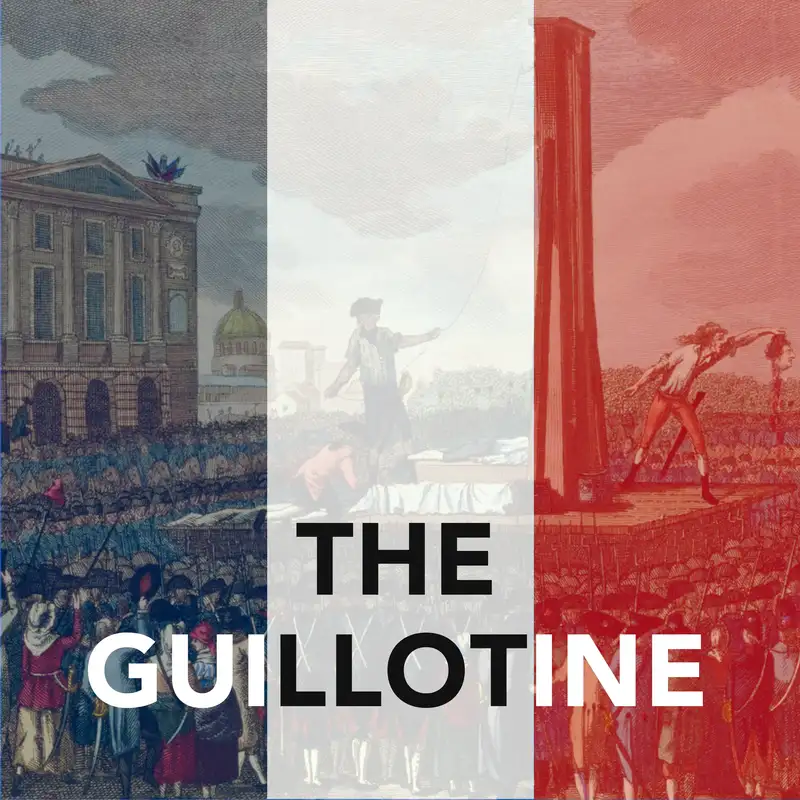
The Guillotine: Grandfather Clock of Death (2/2)
Download MP3tb guillotine pt 2
===
Intro music
---
[00:00:00]
Greetings
---
Dan Slimmon: Soyez les bienvenus Technology Blows listeners. Welcome back to part two of our episodes on guillotines, It's been a, it's, it's gonna be a wild ride. Uh, and welcome back to Johan. Thank you for being our guest,
on these episodes.
Johann: Very happy to
be here. Let's talk about, uh, about this, uh, ads following
Dan Slimmon: Yeah. heads are gonna roll. Not as many as, as rolled in the first episode, but a good [00:01:00] number, decent number. Actually, probably about, about equal to the first episode. but the first episode was roughly the... We covered roughly the 27-month period from the invention of the guillotine in April of 1792 to the end of its real heyday, the Reign of Terror, in July of 1794.
And today we're gonna cover the rest of history up to 2026. Uh, so it's a little bit of a change of pace, and we're also gonna find out whether, how you fared on your guess as to when the last execution by guillotine in France was, uh, which, which we have here in the guest box. I'll take it out when it's time to, to reveal the answer.
How are you feeling about that guess? Did you give it any more thought since we talked?
Johann: Not really. Um, let's see. Let's
Dan Slimmon: All right, we're gonna find out.
Johann: Yeah
Dan Slimmon: those... that 27-month period was, like, a real... [00:02:00] They were, they were really cooking with gas. There was a lot, there's a lot going on in the French Revolution, and so now things are gonna slow down a little bit.
The guillotine beyond 1794: an excellent symbol
---
Dan Slimmon: so it's 1795, right? And the Reign of Terror is over, and France at least has a slightly more stable government.
The guillotine is gonna see a lot less action. but it's, it's already earned its place as an enduring symbol of state power. I mean, you couldn't invent a better symbol. It, it's got that unique slanted blade
that drops from an unreachable height.
Johann: of it. Yeah.
Dan Slimmon: The sound of it, ka-chunk, like very final, very implacable, very, you know, natural force of gravity type stuff.
Uh, it's a real, it's a real... it really just, like, hangs there in your memory. It's the, it's the modern rational state's mandate to kill distilled into a single image, just looming there three meters above the collective [00:03:00] imagination at all times. I, I'm curious, Johann has, has the guillotine survived as a symbol in Europe?
Do people think about guillotines that much anymore?
Johann: Yeah, I mean, I think it's, it's definitely present, present in the, like, uh, collective, uh, you know, uh, thinking, uh, of people as, as a very strong symbol. Uh,
Dan Slimmon: Right
Johann: And
Dan Slimmon: we can talk... Well, we'll, we'll, let's think about what the, what the symbol
comes to mean over the course of this episode, and then we'll... I, I'm curious to get your impression of, like, what it means now in Europe, because we're gonna talk about what it means in the United States, and it means a very different thing, I think.
Um, but it's, it's a great symbol. And if we're... And that's the main thing. If we're being honest, I think being a symbol is the main thing the guillotine is good at. Uh, as we, as we talked about last time, [00:04:00] it's not designed to stop crime, right? You get a... It offers a quick, painless death that's not a, any kind of deterrent to anybody.
And, and you pointed out, I looked this up, um, the, w- because there's only one punishment, there's only one type of capital punishment for everybody, and you can only kill somebody once, uh, there's a thing called, uh, marginal deterrence the marginal deterrence starts to fail.
Ma- marginal deterrence is like, you know, say mugging gets you five years, Aggravated assault gets you, you know, 10, killing somebody gets you 20, uh, that should, that's supposed to, that marginal deterrence at each level is supposed to prevent somebody from moving on to the next level.
But once you've, once you've gone all the way to the top, there's nowhere else to go. You might as well just keep killing
Johann: No cap anymore
Dan Slimmon: Right, right. No cap. That's what the kids mean when they say no cap.
so after the Reign of Terror, The guillotine's not gonna [00:05:00] be good anymore as a tool of collective revenge either, because executions are no longer being held every day high up on a scaffold in the Place de la Concorde.
Uh, they're happening in prison courtyards, right? There's, there's no more razzle-dazzle to them. and the, the guillotine definitely isn't good at what is ostensibly its main job, which is killing condemned criminals. I mean, it kills them effectively, but it's a ridiculous machine. It's top-heavy. It weighs more than an adult pig.
It is expensive to maintain. It's a real pain in the neck to clean. You know, if what France wanted was an efficient way to execute criminals, they would just be still using hanging, right? They would be going with ha- ha- you can hang a dozen people at a time. It's perfectly egalitarian, and it only costs rope, right?
Rope is cheap. Um, it's so much more practical than this crazy Rube Goldberg [00:06:00] contraption that they have
The guillotine's many nicknames
---
Dan Slimmon: There is one thing the guillotine is great at. It's great at occupying space in people's minds, which is why it ends up with so many nicknames. some of my favorites some of these are tough to translate, the Timbers of Justice, they call it, the Bois de Justice.
Le Bois de Justice. Um, the National Razor.
Uh,
Johann: Okay.
Dan Slimmon: it's pretty good. pretty good.
Johann: Yeah, It's
pretty good. It's Pretty good
Dan Slimmon: The Silence Mill.
That one,
Johann: Yeah,
Yeah.
Dan Slimmon: a chill up my spine
Johann: Yeah. Yeah, he does. Le Moulin Silencieux, yeah
Dan Slimmon: Yeah, yeah. There you go. The Moulin sans huile. Le cravate de Capet. Capet being the surname taken by Louis XVI when the monarchy was abolished and he became a commoner. He took the last name Capet, so they call it Capet's one that's great but difficult to translate is [00:07:00] La raccourcisseuse patriotique
Johann: That's a good one.
Dan Slimmon: How would you translate that?
Johann: So someone probably smoked before finding this one. Um, how would I translate this one? Narcissiste patriotique. Uh, I don't know. The, the, the patriotic, uh, shrinker or something like that? Like-
Dan Slimmon: Yeah.
Yeah. it shrinks you, right? It short, it makes you shorter
Johann: it treats you, yeah, for sure. By, by a good head, at least.
Dan Slimmon: Yeah, right.
Feature ideas for Guillotine v2
---
Johann: Uh,
I,
Dan Slimmon: big buildings
Johann: about one thing then. Like, so w- we talked about, like, you know, the first v- v- V1, right? Of the guillotine. do we know, what do we know about, like, uh, the, the different versions that, uh, uh, [00:08:00] have came after that? Was there ever, like, a, a mobile guillotine or, like, uh, lightweight model that, you know, you could just carry around? Uh, was there, like, a double blade one? Like, you know, things like that. I'm curious.
Dan Slimmon: Oh, this one has a spinning blade. This one, yeah
Um, yeah, guillotine with like a, with like a hot dog sensor so the executioner doesn't accidentally slice his thumb off. we're gonna go pretty in depth on the V- V2 guillotine in this episode. The, the... And you're, you've guessed some of the main improvements that were made in it.
Uh, and but they're, they're mostly, as we'll talk about, they're mostly improvements of the, the convenience of moving it around, um, because that, that makes it more administratively useful to the [00:09:00] regime. this, so, so these nicknames, it's just, this is just a small sample. If you, if you go, go to the gui- Wikipedia page on guillotine, there's like 30 of these nicknames.
Uh, the list goes on and on. It's a real rabbit hole. I should, I suggest you check it out. Um, but, but clearly the French are spending a lot of time thinking about the guillotine 'cause the... Right? But they're not afraid of it. It's a meme
Yeah. it's just like
Johann: I I think there's not so
many
objects, right? That, uh, you don't really see regularly, but you still about in like also at school and so on, right? Like e-e-everyone knows about it, even if they
haven't seen one, which is interesting
Dan Slimmon: Yeah, that's true. I'm trying to think of an, of an equivalent. I mean, I guess, I guess methods of execution tend to be that way. Like, um, [00:10:00] like the electric chair, right? I've never seen an electric chair, but we talk about it a lot
Johann: Mm-hmm. Mm-hmm. Yeah
Dan Slimmon: but like from outside of the execution space, it really occupies that space up there with like Air Force One you know, it's, it's like a highly privileged kind of technology.
That's an interesting point
and we think, we think about it enough to just come up with nicknames for it. Right? Like it's not, this is not, that's not the behavior of somebody who's like, "Oh no, I might get my head chopped off at the, the guillotine." That's the behavior of somebody who's like joking about the guillotine all the time
Johann: But I, I, I think interestingly, like, uh, I, I don't think we associate it as much to the reign of terrors and to the revolution itself and like the, uh, you know, the beheading of,
uh, of the, king and, and, and like the higher class. Yeah, I think so, yeah.
Dan Slimmon: that's interesting. I wonder how, to what extent that is an in- [00:11:00] unintentional effect of the, you know, ed- industrial education system and the, you know, to what extent that the re- regimes after Robespierre sort of cleaned that, cleaned up that history for students
Johann: Mm-hmm. Yeah, it could be, but, but also maybe it's just, uh, uh, sort of a free association with like, uh, you know, uh, Marie Antoinette and like, uh, Louis XVI. So you, you know those people, but like you, you don't know like people who have committed a crime and got guillotined, right? So the association is actually, I think probably through, through that, through the, the, the rich people, uh,
Dan Slimmon: it's a great story to have, uh, especially, especially now that we know Louis XVI
up with the blade design. I mean,
Johann: Right.
Dan Slimmon: can't, can't beat that
France's revolutionary Groundhog Day situation
---
Dan Slimmon: Um, now, now the whole, the whole world, the wh- the whole world [00:12:00] knows about the 1789 French Revolution because it's the greatest show on Earth. Like we talked about last time, it's epic. It's got all these heroes and villains, huge armies on the march. Beautiful set pieces. It's en- it's entertainment. And, the 1789 French Revolution kicks off this whole string of other revolutions throughout Europe. Everybody's sort of following the French example, throwing off their chains. By m- the mid-1800s, there've been revolutions all over the place, and secular liberalism is all the rage in Europe, right?
So by 17... Uh, by 1871, a lot of these new European democracies are starting to toy with abolishing the death penalty. Portugal gets rid of it in 1867. The Netherlands get rid of it in, in 1870. Meanwhile, France is kind of stuck in a, like a revolutionary Groundhog Day [00:13:00] situation. they've, they've gone through eight different governments since 1789. They have, they've had the First Republic. That's the one we talked about last time. The First Empire, that's Napoleon. Then Napoleon gets exiled to Elba, and we get the Bourbon Restoration under King Louis XVIII and later Ch- King Charles X, with a slight 100-day intermission for Napoleon reloaded.
Then we get another revolution in 1830, which puts the July Monarchy on the throne. That's King Louis Philippe. The July Monarchy lasts until 1848. We get the Second Republic, headed by Napoleon Bonaparte's dipshit nephew, President Louis Napoleon, who, four years later, does a coup and declares himself Emperor Napoleon III, giving us the Second Empire.
And in 1870, France finally sees the end of monarchy for good with the establishment of the Third Republic under the presidency of the treacherous little worm, Adolphe Thiers. So that's eight, count 'em, eight governments [00:14:00] in just 80 years
Johann: Wow, that's intense.
Dan Slimmon: That's intense
It's like, "Nope, that one didn't work. Throw it out."
yeah, and the
Johann: when you try things and with an
LLM and you just throw it away when it doesn't work right
Dan Slimmon: Ah, whatever. We wrote a whole new law code and didn't, didn't work out. All right. Learn from it. Write the next law code. Nope, that one sucks too
and these governments had, like, nothing in common. They had different laws, they had different structures, different political alignments. I- in fact, almost the only thing that was constant throughout these eight different regimes was the guillotine. W- w- right? Which is crazy, because the French can't agree on fucking anything.
I mean, you put eight French people in a room and tell them to cook one omelet, you're coming back an hour later to find [00:15:00] eight corpses and a dozen perfectly intact eggs. And, right? And yet, and yet for eight decades, every incoming government is like, "All right, we're still using the head choppy thingamajig?
Yeah, cool. All right, next order of business."
Johann: I didn't say it actually, yeah
Dan Slimmon: even the Bourbon Restoration was using the, the... After the, after they threw out the revolutionaries and restored the kings, the Bourbon Restoration was still using the guillotine, and so did everybody else di-did this innovation, uh, innovation exported itself, uh, to other countries?
It, it did. I mean, the, the history's a little complicated because there were head-chopping devices outside of France before the guillotine. But they, they... The g- the guillotine's kind of its own thing. So the, the Netherlands used the guillotine. Uh, I think Switzerland used the guillotine.
The [00:16:00] Germans loved the guillotine. They were all about it. They fallbeil. Oh, yeah. Uh, They had their own special thing. Right. Right. It's very if, if, you know... It's, they love paperwork over there, so, but yeah, it exports itself. I mean, France has colonies, right? It's exported to all the colonies, and we'll, we'll, um...
Uh, the, they have guillotines in, you know, Alger- Algeria, and, uh, French Indochina, and the Martinique all have guillotines
The ferrari of guillotines
---
Dan Slimmon: so in, in 1868, during, still, so still during Napoleon III's Second Empire, Alphonse Leon Berger, who is a carpenter, and more importantly, the assistant to the executioner of Corsica, is gunning for promotion.
He wants to be head executioner. This is, uh, Alphonse Berger, and he sets his mind to developing a new guillotine, a [00:17:00] better guillotine. It's gonna be the guillotine of the future. He never gets that promotion, unfortunately, but his design is solid, and in 1870, the government commissions new guillotines based on Berger's model.
So why is it better, right? It's sleek, it's lightweight, it's fast. It's, it's sort of like the Ferrari of guillotines. Johann, you sent me this, uh, Chanel guillotine picture, uh, that we were talking about last time, and it's, it's ex- this is exactly the vibe, right? This is... This Berger guillotine is just sexy
Johann: Yeah
Dan Slimmon: It's, it's cool, it's sexy. People have never seen anything like it. The old model, it's just steel rubbing against wood and a 15-kilogram weight clunking down at 28 kilometers per hour. since it's all rubbing against each other, like, it breaks [00:18:00] down quickly and you start getting, you know, operational issues, which you definitely don't want during an execution.
the Berger guillotine, this new one, has this beautiful brass housing with shiny wheels that run along, runs along a steel track. So it, it, it makes a much, more satisfying sound, f- metal rolling against metal. Uh, and instead of clunking against the wooden base, the blade supports come to rest against a spring-based damping mechanism that's built into the uprights.
Uh, s- So it's much more engineered and, and it, and it... 'Cause it's like this is post-Industrial Revolution stuff, as opposed to what they were building in 1792. So it's, it's very... It's a nice, compact machine. And, and all this means you can have a much heavier weight. You can have, like, a 40 to 50-kilo weight on top of it instead of, uh, 15, [00:19:00] and you can have a shorter drop, which makes for a more compact machine, you know?
Johann: You can pack it in your backpack and just go
Dan Slimmon: Exactly. Well, yeah, I mean, y- you, you joke, but that was, that was the value proposition. So they, they, they decided in 1870 there was a decree. They-- This, this guillotine ended up in Algeria, and the government found out about it and they were like, "Oh, this is a great idea." So they de- they made this decree that all...
You know, they used to do all ex- all the executions up on a big wooden platform in the public square, so they'd have fewer problems with, like, misalignment and deterioration, 'cause it would be flat and solid. Uh, no longer necessary. The, the Berger model has a new crossbar between the uprights, has extra supports against the ground, which you-- means you can put it directly on the ground instead of on a scaffold, and it's also way easier to take apart and put back together, right?
[00:20:00] Guillotine 2.0 has metal threads and bolts instead of the, the, the screws going directly into the wood, and it, it flat packs like an IKEA sofa
Johann: Now, what would be the guillotine today? Like first it would probably be, there would be ads on it, right? Like most
Dan Slimmon: Oh, for sure.
Johann: It would
Dan Slimmon: Oh, for sure
Johann: like
Dan Slimmon: Yeah. dog, dog food companies would have ads.
Johann: Be like a live counter with a sensor like that knows how many heads have fallen
Dan Slimmon: Yeah. Yeah. There'd be
like a,
Johann: There will
Dan Slimmon: like a dashboard you could get on.
Johann: Yeah.
Dan Slimmon: Man, it would be a whole business.
Johann: It's like pshh.
Dan Slimmon: this, this new one can be set up in just three hours instead of taking all day to [00:21:00] set up, and it's take- it can be taken down in less than one hour.
So, and it, and it, and like I said, it flat packs, so you can just, like, ship it around from one place to another so that you can have, like, a given region in France will have one guillotine, and they'll just ship it around to the various prisons that it needs to be used at and send it back. Um, like Netflix.
You know, it's more of a Net- Netflix model than, uh, early Netflix model than, you know, brick and mortar.
Portability changes the whole game
---
Dan Slimmon: So it's just more reliable, more mobile. They no longer have to have the prisoners come to the guillotine. The guillotine can go to the prisoners, and they, uh, set it up in front of the prison before dawn.
They bring the client out, fwoop, k-chunk, it's all over in 30 seconds. Take the thing apart, ship it back to HQ, and it's, it's like a, it's a [00:22:00] disruptive te- it really is a disruptive technological innovation. Because they can get this all done before breakfast, before anybody is, like, out to see it.
They don't have to make it a big public spectacle anymore. which makes it, like, which disrupts kinda the symbolism of the, of the guillotine, because it doesn't loom in on a scaffold anymore up in the public square. It, it's just, like, there, and it's gone, and unless you get up really early, you don't get to see it in action
so a- as is the case with every disruptive technology, not everyone is thrilled with the Berger guillotine.
The Paris Commune rejects the guillotine
---
Dan Slimmon: And on March 18th, 1871, the working people of Paris seize the city from the Thiers government, which has just been humiliated in the Franco-Prussian War, and they proceed to set up their own government, which comes to be called the Paris Commune people over here in America don't know about the Paris Commune, and they should because the Paris Commune kicks ass. They, they only control the city for about [00:23:00] 10 weeks. But during those 10 weeks, the Communards establish worker ownership of businesses. They separate church and state.
They abolish the police. They abolish rent. They abolish child labor.
know?
Johann: In 10 weeks
Dan Slimmon: In 10 weeks, yeah. I mean, right, pretty much immediately at the beginning of the 10 weeks. the, it's like August 4th all over again, where they're just like, "All right. Out. All these old laws suck. We don't like them." the only thing stopping all of the good things from happening immediately was the machine of, domination embodied by the, the Third Republic government and all the, all the governments before it.
which is, which is amazing. Uh, but of course, they're doomed. That's the problem. That's the main problem with the Paris Commune is they're fucking doomed. cause the city is surrounded by the now provisional government under Thiers. He's, he has lost to the Prussians, and he has struck a deal with [00:24:00] them to let him stay in power if he gives them back Paris and put all those kids back in the soot factory where they belong.
So with Paris pretty much under siege, the Communards start running out of food and bullets pretty much right away. while they still can though, they, they get busy seizing the means of production and using them to serve the needs of their fellow Parisians, which as I said, rules. The, the guillotine, though...
So they're seizing the means of production. The guillotine is not a means of production. It's, it- the only thing it produces are, are fear and death. So it's of no use to them. They, they don't need it. And I, now I'm gonna read a proclamation issued by the Communards in April of seven- 1871. It goes: "Citizens, we have been informed of the construction of a new type of guillotine that was commissioned by the odious government, one that is easier to [00:25:00] transport and speedier.
The subcommittee of the 11th arrondissement has ordered the seizure of these servile instruments of monarchist domination and has voted that they be destroyed once and forever. They will therefore be burned at 10 o'clock on April 6th, 1871 at the, on the Place de la Mairie for the purification of the arrondissement and the consecration of our new freedom."
Johann: And is that the end? I guess not
Dan Slimmon: Well, they did. They did do it.
Johann: It did? Okay
Dan Slimmon: Yeah, they brought these two... They brought the two new Berger guillotines to the foot of the statue of Voltaire in the Place de la Mairie. Voltaire, who represents those rational, like, Enlightenment ideals that, that their great-great-grandparents were embracing when they invented this machine in the first place, and they doused those two guillotines in petrol and set them on fire
Which is significant because it makes, this means the Paris Commune is the first government [00:26:00] in the 80 years since the guillotine's invention to refuse to turn the machine against their own enemies
Now, of course we can't have nice things. The army comes back from Versailles under the leadership of that monstrous gnome, as Marx called him, Adolphe Thiers. And the Versailles army is well-fed, well-supplied, and they have Prussian support, so they take back Paris right away, um, in, in what comes to be called the Bloody Week, killing 10 to 15,000 communards in the process.
And the Third Republic, reintegrates church and state, brings back child labor, and brings back execution by guillotine. So hooray, we're back to, we're back to normal
Johann: cycle, right?
Dan Slimmon: Right The Third Republic ends up lasting 70 years, which is almost as long as all the previous governments since the Ancien Régime combined during [00:27:00] which the guillotine is becoming more and more embarrassing because France is the only European power during this time still doing public executions
by the eve of World War II, the only other European nation that still beheads its criminals at all, much less in public, is... Well, do you wanna guess who the, who the only other country at, at the beginning of World War II who's still executing their criminals by beheading
is Switzerland
Johann: Switzerland?
Dan Slimmon: Switzerland's still doing it.
Johann: Was there, was there a patent on the guillotine?
Dan Slimmon: Well, the, maybe the Berger guillotine. Let me see. Um, was the Berger guillotine patented?
He did not patent the design. He mostly was using it as, like, a way to get promoted, right, by the French government. And so what he wanted was for the adoption to just take off right away, right? And it's not, it's not like he was running a private company anyway, like [00:28:00] Berger's Quality Guillotines.
Johann: But I guess it was, they were manufacturers of this, right? So, somehow. Or was it just like
Dan Slimmon: yeah. I mean, it was, it was car- it was, I think it was just carpenters, like private carpenters who put it together. He built the first one and just probably showed somebody else how to do it, and then they started exporting them
we, you know, what was it, 1870 something? Say 1868. So, you know, we already had, they already had like steam trains and mining equipment and stuff. So it wasn't, it wasn't like a technical marvel by industrial standards. Uh, right.
It was just like a more, um, a, a better, flatter way to do it
The last public guillotining: Eugen Weidmann
---
Dan Slimmon: so, so the, the, the Third Republic's around for 70 years until one day, and so they're doing executions by guillotine in [00:29:00] public, until one day in 1939, France comes together as a nation to execute a true piece of shit, the serial killer Eugen Weidmann, who is a German-born French serial killer.
in 1939, his, his story, his trial has become this huge news story, largely because one of his murder victims was this beautiful, well-to-do American ballerina named Jean De Koven. you know, you, if you murder a ballerina, everybody's gonna be on your case now, right? So, uh, every- it's all over the papers.
Everybody wants to, everybody wants this, this guy killed. He killed, like, five other people. I wouldn't... It's, it, they call him a serial killer. Uh, he's more of, like, a, just a criminal whose MO was to kill his victims before stealing their, stealing all their money. So Weidmann's execution day comes on June 17th, 1939, and [00:30:00] normally they try to get the whole execution done before breakfast, right?
But on this day, apparently they have some trouble setting up, and the guillotine isn't ready until midday, which means by the time it's set up, there's a huge crowd gathered in the street. Um, some, some estimates say up to 20,000 spectators Yeah. It's a, it's a huge event. Everybody's telling their friends, " they're yelling and cheering as Weidmann is brought out to the guillotine. Weird little factoid, one of these spectators, one of these 20,000 people evidently pretty close to the action happens to be Christopher Lee, the actor. Um, yeah. If, uh, for, for those who don't know, Saruman from Lord of the Rings is where I, uh, ha- know him from. His friend woke him up early. He was like, "Hey, there's gonna be an execution, and they're setting up late. We could go watch it." French TV interviewed him later, late in life about it, and he said he was disgusted by the whole [00:31:00] thing and ashamed to, to be there.
He couldn't look when the actual blade fell. and they, uh, uh, any time a non-Frenchman speaks in, excellent French, they always have to mention it.
Like, Christopher Lee, the British actor r- told, told us in perfect French about his, uh, time watching this execution." anyway, he was there. That's the point of that story. most people in the crowd were not ashamed.
The, they were... After the guillotine was removed, several people rushed forward to soak their handkerchiefs in Weidmann's blood before the officials could get the hose ready
Uh, It's very 1792 behavior for 1939, I would say
Johann: Yeah, I think so
Dan Slimmon: put it on your, put it
Johann: have, uh, weird behaviors, no? Like maybe it's, uh,
Dan Slimmon: Yeah
Johann: something about that, about like
crowd behavior or something
Dan Slimmon: Right? it's not pretty. Nobody likes it. [00:32:00] Uh, and I don't know, I wonder if these people had, you know... But what did he, what he...
Did they, like, put their handkerchiefs, did they frame them and put them on the wall? Like, uh, what do you do, right? But the, the, the government definitely does not like it. This, this like a... They're like, "Oh, this is a, this is a big collective faux pas by the French people." Uh, so immediately, the day after this, the, the government bans public executions in France from now on.
No more public executions, they say, because they, because they don't seem to be having the desired moralizing effect on people. That's, that's their, their reasoning. Execu- public executions are supposed to make people act more morally, and going and soaking your handkerchiefs in the blood of the executed person is, is
not really doing that
Johann: Moo. Yeah. For sure
Dan Slimmon: a- although, as Camus points out in his 1957 essay, [00:33:00] Reflections on the Guillotine, this is kinda backwards logic, right? 'Cause how can executions have a moralizing effect on people if nobody gets to see them
Camus says like, well, if we want, if we want the executions to make people act right, we should be televising them on all the channels
Johann: Yeah.
Dan Slimmon: Right? But instead they're like, " watching the executions is causing them to act bad." Okay. Well, then why do we have the executions again?
Johann: It's interesting
Madame Guillotine goes to Vietnam
---
Dan Slimmon: so from this point on, executions are gonna be done behind a black curtain in a prison yard. Uh, they, they set up a curtain before they, they, they build the guillotine, they set up a curtain, they do the execution behind the curtain, then they ship it, ship it back.
But, but still, They can't stop using the machine. They have to use this ridiculous, like, grandfather clock of death because that's what they wrote down in 1792, [00:34:00] and eight governments and 147 years ago, that's still what it says in the Constitution
Johann: So I was pretty wrong with my date, right? Like saying it's end of
Dan Slimmon: But yeah, we haven't even gotten there yet. We're, we're still, we're still pretty far off
right? Go-- It's really hard to... It's, uh, you know, one government goes out, but the n- the next government comes in, they still have people to kill, and they-- Rather than have to come up with new laws about how you're allowed to execute people or not, that might be contentious and might cause, you know, people to argue, they're like, "Well, the last guys were using the, the guillotine, so if we keep using the guillotine, nobody can complain that that's a problem, right?
So we'll just keep using it." it survives for so long. The guillotine even survives French rule itself. case in point, Vietnam. [00:35:00] Vietnam was a colony of France until Ho Chi Minh drove out the colonizers in 1954, after which the country was divided into communist North Vietnam and an authoritarian nationalist state in South Vietnam under a leadership of President, and I don't, do not...
I'm much better at pronouncing French than Vietnamese, President Ngo Dinh Diem
this is, you know, what happens when you, you, you have a colony for a long time and then you leave. Turns out they, they don't really have the structure to, to hold up one country anymore, so,
Johann: There's quite a few stories like that actually,
Dan Slimmon: Yes.
Certainly something the United States has never done, so just, just you guys over there. What, one of the biggest problems Diem has to deal with in the late '50s is there's a growing communist resistance within South Vietnam's borders.
You know, in, largely in the village. It's hard to, it's hard for Diem to, to, like, clamp down [00:36:00] on all these different communist resistance cells because they tend to hole up in these remote mountain villages and so in May of 1959, the National Assembly of South Vietnam adopts something called Law 1059, which is a law that says that if you're suspected of, quote, "crimes with the aim of sabotage or of infringing upon the sec- security of the state," the government is allowed to impose a death sentence on you through a military tribunal.
This remind you of anything from last time?
Johann: Yeah, it's something we talked about, right?
Dan Slimmon: It's exactly what Robespierre did.
Johann: Yeah.
Dan Slimmon: It's, it's exactly the law of suspects, that allowed the Jacobins to round up anybody suspected of counter-revolution, which was basically anybody they wanted. Same, same exact deal. Um, except it's happening in Vietnam in 1959 instead of in France in 1792, '93.
And Diem is like, "Hey, [00:37:00] do we still have any of those guillotines left over, you know, that the French were using to kill us?"
Right? Which makes total sense Cause whether you're a J- radical Jacobin in 1792 suppressing Catholic priests, or a colonial governor in 1910 suppressing Vietnamese resistance, or a Catholic nationalist in 1959 suppressing communist guerrillas in the foothills, if you're a state and you wanna win an argument, you're gonna reach for the national razor
it's just great for that. So, so the, the DM government literally puts guillotines on the horse carts and sends them out to the countryside. you know, you see, you see the army approaching with a rattling cart and the guillotine set up high on the cart just, like, ready to go which is chilling
And those guillotines in the countryside do the two things that guillotines always do. One, they stand as a powerful symbol for the autocratic government in the [00:38:00] capital. And two, they utterly fail to frighten the people into submission. One member of the peasant resistance said later that because of Law 1059, quote, "New life was blown into the political movement, and a patriotic appeal was made to overthrow the government of Mr.
Diem because this government was killing people like that. So it led to another war and renewed fighting."
Johann: So it's a bit counterproductive
Dan Slimmon: c- it's a bit counterproductive, I would say, yeah
it's, you know, it's just like the network of underground priests in the Reign of Terror. It just makes the network of people resisting you stronger the state can control where the guillotine goes and whom the guillotine kills, but the state can't control what the guillotine means to the people who remain after it's been carted away
France ends capital punishment
---
Dan Slimmon: So eventually France does finally end capital punishment. the last execution in France took place in [00:39:00] 1977 So you're off by 82 years
Johann: That's interesting because '77 is the year I was born.
But the, death penalty was, uh, abolished after that, right? So that was just the guillotine in '77, and the death penalty, I think, was just like '81 or something, '
Dan Slimmon: 81 is correct. '81 is correct, but the, um, between those two years, they... It was another situation where, like, people were waiting for the death penalty, but there just were no more executions during those four years. So the last execution was '77. The, they officially end the death penalty in 1981
Johann: I see. A-and the last execution was with the guillotine or
Dan Slimmon: Oh
Johann: Okay. That I
I, I[00:40:00]
actually, that never registered with me that until that day it was used. Like, I don't think many people are actually conscious of that, interestingly, right? Like we-- 'cause we do associate guillotine to like the French Revolution, but like, we don't really think about what happened next And, and clearly I didn't have in mind that it was retired when I was born. That is insane
Dan Slimmon: It's insane, right? don't know if they were using
Johann: are taught that at school actually, you know? I don't think so
Dan Slimmon: at the very least, it's interesting from a technological perspective to see that, like, this same machine that is more or less the same since 1792 with some improvements, was, you know, still being used in 1977, not because of any moral argument that anybody made [00:41:00] about it, not because of, uh, you know, in, in, not, not because of any immoral argument people were still making in 1977, for sure.
but just because, you know, you glom onto something, you make it the law, and now
that's the technology
Johann: Exactly, yeah. Yeah
Dan Slimmon: and, and even in 1981, there wasn't really any particular, like, popular outcry to end the death penalty. It, it was more ended just because it was embarrassing to be the last Western European nation still executing people. The, the percentage of people who, French people who support the death penalty still to this day hovers around 50%.
It's like 50, four- four- 45% or so
Johann: Actually, I'm, I'm not that surprised somehow. I'm not that surprised. think
Dan Slimmon: w-
Johann: also a, a, a
failing of the probably of
the, uh, of the whole system, right? That, uh, I mean, if we look at, uh, the, the news from the, the last like few months, [00:42:00] uh, clearly sometimes, uh, there are major failing of the, of the justice system in, in France where don't get, uh, sometimes even charged for what they're doing or, or not charged enough, right?
Like for the gravity of their act. Uh, and, um, and so guess that contribute to people wanting more extreme and severe, uh, penalties than, than just jail. Because eventually everyone gets out of jail at some point, and most of the time earlier than, uh, than they should.
Dan Slimmon: So you think it, it's, you think it, you would say it's, it's like a perception issue based on, well, people aren't getting, not enough people are getting punished to the degree that they should, and so let's,
like, up the ante
Johann: Yeah, I think so, yeah. Uh, I [00:43:00] mean, there's, there's been quite a few cases lately of like, uh, serial raper, abusing of kids and, and whatnot, who, didn't get basically the sentence that they... Or the, the, yeah, the, the penalties that they should have had, and, and then could, you know, do things, uh, a-again and again.
And I think that, that is what makes people go extreme and be like, "Okay, I guess the only solution is to just end their lives," right? Like, because the, the, the prison system doesn't, uh, or the justice doesn't condemn them, uh, to, uh, long enough penalties that know they're not going to do it again.
Dan Slimmon: Right I don't know.
The guillotine as a symbol of class war
---
Dan Slimmon: In the US, like, we... Support for the death penalty in the US is around 54%, so a little bit higher than France, but [00:44:00] we're roughly in the same ballpark. Uh, but we don't have any personal experience with the guillotine over here. So to us, you know, the guillotine doesn't symbolize the state's mandate to kill.
If, if anything occupies the space in that, our imagination, it's, it's probably the electric chair, um, or I think probably the, the riot, the riot shield occupies a lot of space in our imagination as the, as a symbol of, like, the state's, um, uh, monopoly on, on public space and on violence. what, what we know about the guillotine over here is the common people of France used it to do away with their corrupt, wealthy overlords.
That's it. So to us, it's a symbol of class war. Um, you see the guillotine a lot on edgy posters at protest marches, uh, as like a threat to the rich. [00:45:00] Sometimes if somebody's feeling especially saucy, you'll see it, the severed head of, like, Jeff Bezos or Elon Musk next to the guillotine. Saw that a lot in Seattle with, uh, with Jeff Bezos.
Uh, the other day I saw someone showing off a tattoo on social media, which was a picture of a guillotine with roses growing out of it, and underneath it said, "This machine kills fascists." And
I mean, come on, you, you can't tell me the guillotine is a machine that kills fascists,
Johann: No
Dan Slimmon: right? It was extensively used by the Third Reich.
Like, I get the desire to make the rich afraid. I think they've created... The rich have created a utopia just for them by squeezing everything good from the lives of, of everybody else, and that they should be afraid until they cease to exist. But the guillotine does not make the rich afraid.
The guillotine kills whomever the state wants [00:46:00] dead, right? For a brief moment in 1792, that happened to be mostly former aristocrats. But very soon after that, we were- they- Robespierre was using it to kill mostly commoners, right? right now in the US we have a state controlled by the rich. So if the guillotines come out at this moment, it's not gonna be Jeff Bezos with his head in the lunette.
It's gonna be people suspected of being Antifa
maybe some, I think some, a lot of people think the guillotine will be used by a revolutionary government. You know, get it, have a revolution first, and then that revolutionary government is gonna abolish class and use the guillotine to punish the, the landlords or, or whatever. But if class is abolished, then so is the line that separates Elon Musk from you and me, and if the guillotine is used on him, it can just as easily be turned around and used on everybody else.
Alternative symbols for revolutionary violence
---
Dan Slimmon: So I think the [00:47:00] American left ought to look elsewhere for symbols of class justice, and I have a few suggestions. The red flag is always good. That worked for the Paris Commune. That's worked for, uh, a better... more than a century. Can't go wrong with a red flag. Mario's brother, Luigi, has been doing a lot of heavy lifting lately as a symbol, for, for, like, non state-approved leftist action.
I won't go into why, but, you know, Luigi's pretty good on a poster. Everybody knows what that means. Uh, I'm partial to the Titan submersible
Um, you know, the, the, um, the submarine that, with the people who, uh, got grifted into going down, uh, to see the Titanic and then, right. Yep, that's a, that's a, that's a decent symbol to put on. It's pretty, pretty photogenic to put on a poster. But for, for my money, the best symbol for the struggle against oppressive power is the Molotov cocktail.
You can, you can build [00:48:00] one with common household items. You know, it doesn't require a big government research project involving sheep and, you know, the king telling you what shape the blade should be. You can just make one in your kitchen, uh, or your garage. It's, it's optimized for popular movements operating out in the open.
You c- y- you know, you can't hide Molotovs behind a black curtain in a prison courtyard. And, uh, it's sort of a trump card against the top-down organized forces of order. You know, they were, They were invented to fight tank warfare in Finland. and they're, they're good at, they're good in a riot because you can't pepper spray a fire, right?
Johann: Of course, yeah. Yeah
Dan Slimmon: so I don't know. Those are, those are my, those are my suggestions for good symbols for the left. Um, I think we, we ought to, we ought to set down the, the guillotine as a symbol. It's not a, it's not a, you know... It's a machine that kills fascists.
There, there's a reason Woody Guthrie wrote the machine, "This machine kills fascists," on [00:49:00] his guitar. a state can't use a guitar to whip up violence against people. but uh,
Bye bye!
---
Dan Slimmon: I hope I've convinced you, Johann, to finally get rid of the, the guillotine that I know you keep in your backyard
Johann: Yeah. Uh Harvard Art to Heal the World
Dan Slimmon: Art. Right?
Johann: Art, think makes the mind also feel better and at peace, I guess. And I
Dan Slimmon: Yes
Johann: that's what humanity needs, no?
Like, uh, not another way to kill people or, yeah, to, uh, cause pain. But, uh, I don't know. I, I always... I, I often think about how our humanity is so brutal somehow and still very much primitive in many, many ways. Uh, [00:50:00] a-and why do we need all that, right? Like, is it that, uh... I, I'm, I'm really curious if there's like other civilization out there which have figured how to live in, in harmony somehow, and is this-- is tied to our, our biology that we just cannot get there somehow? Like, not with, you know, laws or, uh, anything really. Like, uh, always goes back to violence in, in, in many ways, uh, which,
Dan Slimmon: Yeah
Johann: a bit sad. And yeah. And I think
art is a way to escape that and, and at the same time to give a message, right? Um,
Dan Slimmon: Like the Chanel guillotine so that's what we think everybody, you know, make art, don't chop off, don't chop off heads with a [00:51:00] guillotine You heard it here first. thank you, Johann. This has been an awesome conversation. I'm really, um, I'm really glad we were able to get into it.
Johann: Thanks.
Dan Slimmon: uh, so I wanna tell people, we've got episodes coming up on high-frequency trading.
We've got an episode on QR codes that's in the works. we've got an episode, uh, that I'm calling Fat RoboCop about a, uh, police robot that, uh, you're gonna love that's been in the news lately. So tell your friends, get on that social media, follow us on Instagram, uh, subscribe, like and subscribe on YouTube.
And, uh, thanks again to Johann. This has been an awesome talk, and,
Johann: Thank you
Dan Slimmon: I hope to have you on again sometime soon.
Johann: Yeah, of course. Thank you. so much, Dan.
Dan Slimmon: All right.
Johann: Bye-bye.
Dan Slimmon: Blows. I'm Dan Slimmon. see you soon
[00:52:00]